
Fallen Empire - Chapter 2: The Blueprint of the NIFB
- Joseph Lucketta
- Oct 1, 2025
- 8 min read

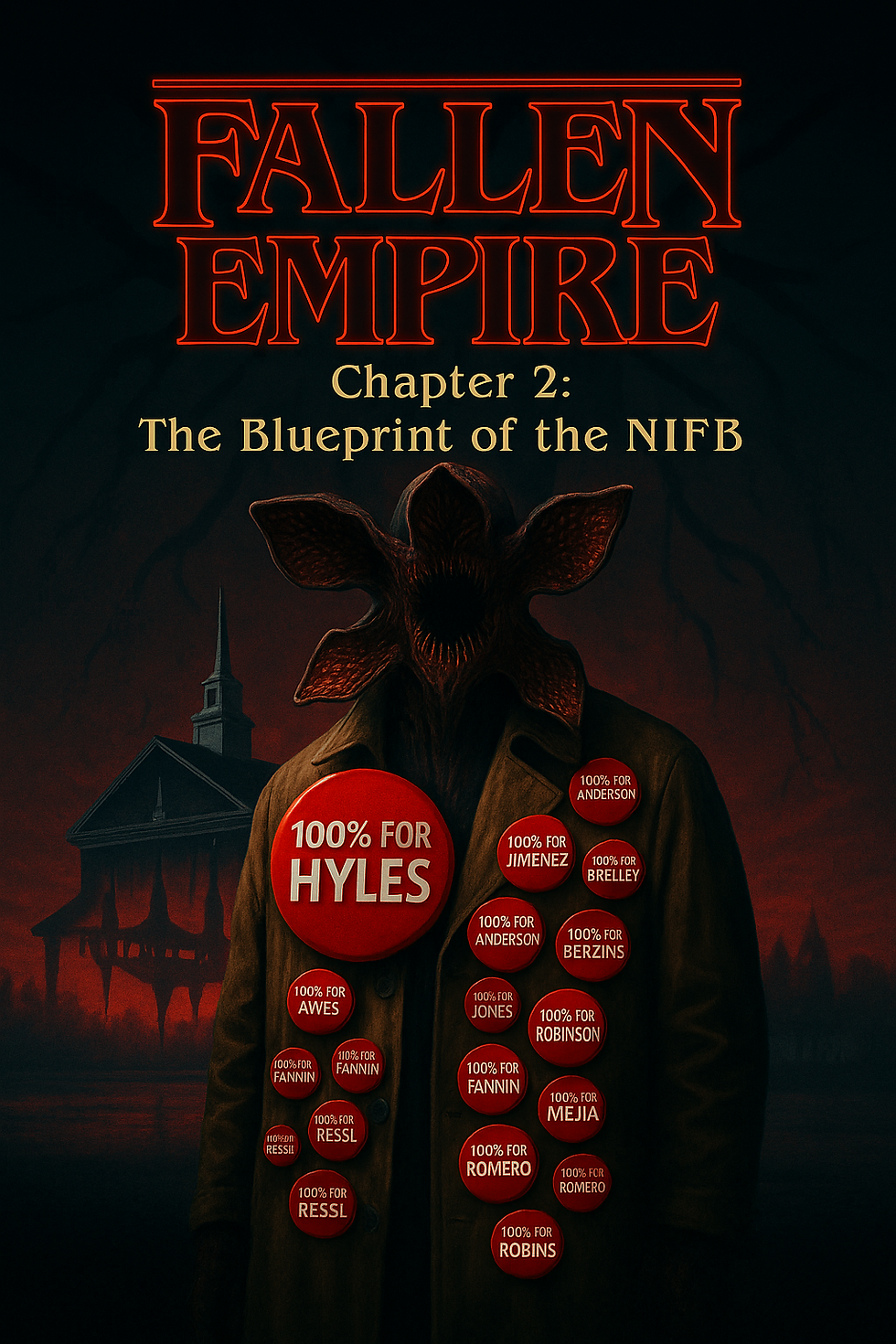
On some Sundays at First Baptist of Hammond, people pinned little circles to their suit coats: “100% Hyles.” It wasn’t a doctrine; it was an identity badge that said, our preacher is beyond question. The atmosphere felt less like a church and more like a movement with a man at the middle. If the independent Baptists had a pope, many said, it would have been Jack Hyles. When allegations surfaced about Hyles’ marital impropriety, the reflex wasn’t let’s test this in the light. It was circle the wagons, this is an attack from Satan, keep the machine running.
The recent documentary from Spencer Smith, “Disclosure,” names the machine out loud: turn ministry into a production line where growth is the measure of godliness; cheapen the gospel into quick decisions; elevate the pastor until to question him is to question God; overwork the people and under-feed their souls; and when moral failure finally breaks the surface, don’t stop the machine—toss the broken part and replace it. That’s not an accident. It’s a blueprint. And it traveled—straight into the NIFB.
Watch the documentary "Disclosure" here
Question: What if the NIFB didn’t innovate a new way of doing church at all, but simply rebuilt the same old machine with a little new paint? Chapter 2 of this ongoing series takes a look at the heritage of the old IFB and attempts to expose the manipulative tactics that worked their way into the new IFB movement. Furthermore, we’ll attempt to take an objective look at the endemic issues within today’s IFB and seek to answer whether we need to reform the church or find something else altogether.
Today’s history lesson - How Jack Hyles became “Hyles”
In the late 1950s and early 60s, a pack of pastors soured on the Southern Baptist Convention’s drift and planted their flags in “independent” soil. Hyles came to First Baptist Church of Hammond (Indiana) in 1959, found a blue-collar town next door to Chicago, and dreamed big. He built numbers through a bus ministry that became the stuff of legend: hundreds of buses, armies of workers, and a scoreboard culture where numbers were proof of God’s blessing. If it moved, it was a prospect. If it prayed, it was a notch. The deeper the totals, the deeper the “amen.”
Hyles also founded Hyles-Anderson College (1972) to replicate the model—turning “independent” churches into practical spokes that all pointed back to Hammond for inspiration, staffing, and style. In theory, each church was autonomous. In practice, the college and the conferences created a hub-and-spokes system with Hammond at the hub.
And with the growth came a subtle shift in gravity. Sermons often started with a verse and quickly pivoted to, “Close your Bibles and listen to me”—a line people from that era still remember. The message beneath the message was clear: authority lives in the man. Loyalty wasn’t just encouraged; it was performed - the well-known platform stunts where deacons were told to sit, stand, sit, stand on command, or where a staff member was told to drink from a bottle labeled poison to display absolute trust. You don’t do those theatrics unless your church has already accepted that the pastor is the product.
Meanwhile, the cracks showed. “Disclosure” catalogs the pattern, and other investigations fill in the details: man-worship, unquestioning loyalty, ‘quick-prayerism’ decisions, and a defensive reflex against anyone who questioned the man of God. Add to that a train of scandals: the Jennie Nischik affair allegations, the serial moral implosions of Dave Hyles, and eventually, after Hyles’s death, the arrest and imprisonment of his successor Jack Schaap for transporting a minor across state lines for sex. When that dam finally burst, it wasn’t because the system reformed itself; it was because federal law got involved. The machine never apologized; it rebranded.
Hyles had a phrase for dissenters: “touch not the Lord’s anointed.” In practice, it meant don’t test, don’t question, don’t check the fruit. If you’ve ever sat through that kind of culture, you know the feeling - FOG: fear, obligation, guilt - thick enough to choke.
And yet the movement was bent, not broken. Even with the wreckage, the IFB brand continued to attract people who wanted clear lines, soul-winning urgency, and strong authority. Which is why a young man named Steven Anderson could walk into the story and sincerely believe he could keep the bones and fix the rot.
A phoenix from the ashes?
After a stint at Regency Baptist (Sacramento) and three years at Hyles-Anderson (he left shortly before graduating), Steven Anderson planted Faithful Word Baptist Church in Tempe in 2005. In word, the project sounded like reform:
Fix the doctrine. Reject dispensational timelines and soft-pedaled judgment; anchor in the KJV; push a post-trib, pre-wrath eschatology; hammer once-saved, always-saved; torch heresy.
Minimize scandal. Move to family-integrated services (no kids’ programs), arguing that abuses in the old system happened when adults were away from parents.
Shut down the “old-boys” pipeline. No Bible college network; ordain in-house; prove yourself by your evangelism and loyalty, not your résumé.
Standardize the scoreboard. Weekly, confrontational, door-to-door soul-winning as a baseline expectation - and publish the numbers.
Go online. Sermons, documentaries, and shock-clips on YouTube to build reach and recruit.
If the story ended there, maybe this chapter wouldn’t exist. But in deed, the NIFB rebuilt the same hierarchical, personality-centric architecture it said it was escaping.
The man at the top. In the NIFB, as in Hammond, the “man of God” functionally sits above review. You’re independent until the leader speaks; once he speaks, independence means aligning with him. Critique seldom lands as sharpening; it lands as rebellion. (Watch how often dissenters get labeled “bitter,” “backslidden,” “reprobate,” or “sympathizers.” The label comes first while the listening rarely comes at all.)
Loyalty as lubricant. “100% Hyles” became policy in a new skin: don’t just agree on core doctrines; agree on his doctrines, including: post-trib timing, anti-zionism/replacement, KJV-only to the hilt, anti-Calvinism, reprobate doctrine, strong anti-politics, anti-military service, and a presence at weekly soul-winning. That cluster doesn’t operate like a confession; it operates like a shibboleth.
Machine metrics. When numbers become proof of God’s favor, people become means. “How many doors? How many salvations? How many baptisms?” The temptation is ancient: pragmatism when it’s useful, and, let’s be honest, Machiavellianism when it’s costly. In narcissistic systems, the ends justify the means: silence the critic, move the problem, protect the brand.
Brand over bodies. Once your pastor is the product, individual failure becomes an existential threat to the whole brand, and so the brand must be defended at all costs. That’s how institutions end up reflexively discrediting victims, minimizing evidence, or shifting blame onto “bitter” ex-members. It’s also why people who leave suddenly discover they were addicts, adulterers, or conspirators the whole time - at least according to the next sermon. If you’ve ever sat under it, you can feel the DARVO pattern in your bones: Deny. Attack. Reverse Victim and Offender.
And about “family-integrated”? Yes, it addressed one specific old-IFB failure: children hidden in unaccountable spaces. But the blueprint didn’t change. Instead of addressing power, it moved risk from the hallway to the living room and from Sunday school to the group chat. The machine was still intact.
Why the blueprint works
Systems like this need two ingredients.
First, a “cult of one.” The leader projects a grandiose false self - always right, always bold, uniquely called. Disagreement hits him not as data but as defection. If he’s cornered, he doesn’t restore trust; he demands it. The sermons repeatedly frame the church as a righteous remnant, the pastor as a lightning rod, criticism as persecution. That’s not shepherding; that’s narcissistic supply in a suit.
Second, a fawn-and-fight feedback loop. In your average NIFB church, you’ll find a lot of good people with soft boundaries (the fawn response) who compensate by working hard, soul-winning, giving, volunteering, because that’s how they’re taught to be “faithful.” They pair up with a fight-mode leader who pushes boundaries, tests loyalty, and punishes dissent. Together, they enter a shared fantasy: We are the 1% of Christians. We’ll get the best rewards. No one else is doing what we’re doing. No one holds standards like us. We are the righteous remnant. Until you question. Then the fantasy flips, and you become the enemy.
Tie those two together with tiers of access - the closer you are to the “man,” the more platform, praise, and protection. And now you’ve got a hub-and-spokes system that feels independent and functions like a court.
Why the blueprint fails
Here’s the dirty secret: the NIFB kept the same collapse vector as the old IFB—personal scandal → loyalty tests → splintering → smear campaigns → revised history. When the man falls or is crossed, the whole structure shakes.
Survivors feel crazy. Gaslighting, FOG, and DARVO erase your memory while demanding your devotion: We never said that. You’re bitter. If you loved Jesus, you’d submit. You second-guess your eyes, your texts, your timestamps.
The Bible gets bent. Narcissistic leaders can’t long live inside 1 Timothy 3 and Titus 1 without either changing or changing the standard. So, the preaching shifts: more heat on your supposed sins, less light on accountability; “touch not the Lord’s anointed”; “two or three witnesses” wielded like Kevlar unless the problem is you.
People become sacrifices. Black-and-white thinking means the pastor must present a flawless self at all times. Any shame that leaks out is offloaded onto a body - a member, a family, a staffer in order to purchase the next week of calm. In the old days, victims had nowhere to tell their story. Now there are platforms so that the wake of destruction catches up with the narcissist leader.
The next generation learns the wrong lesson. When leadership pipelines reward mirroring the man over shepherding a flock, you don’t grow pastors; you mint proxies. The brand continues, but the people starve.
If you want a harrowing case study of a machine that ran people over and still tried to keep rolling, read numerous studies of the Hammond years and what followed: unquestioned loyalty expectations, man-centered preaching (“close your Bibles and listen to me”), stunt-displays of control, a decade-spanning affair allegation war, and finally Schaap’s conviction: twelve years, plus registration as a sex offender. Even then, the instinct in parts of the system wasn’t repentance; it was control the narrative. That’s what corrupted machines do.
Change the system, or change the man?
There are healthy IFB churches. Solid doctrine, real shepherds, and yes—soul-winning that happens with or without the NIFB swagger. God isn’t bound by our brands. But the broader IFB ecosystem - fast-forgiveness for stars, soft boundaries in pews, and suspicion of oversight is a near-perfect greenhouse for narcissistic leaders to grow.
If you’re inside one of these churches, you don’t need me to tell you that. You feel it in your body. The question is, what now?
Here’s where I land, as someone who believed the best for a long time and paid for it later:
You can’t out-perform a narcissistic system. Working harder makes you useful, not safe.
You can practice radical acceptance if you must stay in a corrupted church: name what it is, stop looking for empathy where there is none, build hard boundaries, and keep your identity anchored outside the church brand. It’s survival, not transformation.
Or you can begin to step away - first in your heart, then with your feet toward leaders whose authority looks like servant leadership and whose ministry looks like feeding the sheep.
Either way, you’ll likely need to do some hard inner work: grieving the lost dream, disentangling your faith from a man or a movement, and replacing FOG with clarity. That’s not weakness. That’s healing.
On-ramp to Chapter 3
Next up, we’re going to get specific. Chapter 3 zooms in on personalities: how leadership is groomed to mirror the leader rather than trained to pastor a truly independent church, how hub-and-spokes loyalty is enforced, and how the platform (and the pulpit) becomes a tool to shape reality itself. If Chapter 2 showed you the blueprint, Chapter 3 will walk you through a built house, room by room.


Comments